- Owned and Operated
- Posts
- An Underused Marketing Channel


Welcome to the first 2026 edition of “Clicks to Calls.” If you missed the last one, you’ll want to read it here. It’s all about a high-ROI marketing channel you may be ignoring.
Today, I’m drilling down on another marketing channel that entirely too many home service companies overlook: Facebook Groups.
It sounds sort of strange on the surface, I know. But stick with me…
/Check out these resources before you go any further…
The solution to “winning the map pack” in every market you serve
Google Ads added a change history shortcut that lets advertisers jump straight to affected campaigns and ad groups.

Are You Overlooking Facebook Groups?
This week’s breakdown focuses on a channel most service businesses either ignore or misuse: Facebook groups.
In local markets, these groups are where real buying intent shows up. Homeowners ask for recommendations when the job matters and the risk feels high. That makes them fundamentally different from paid ads or generic social posts.
The mistake most operators make is treating groups like another ad placement. The operators who win treat them like a community. They show up without pitching, tell a consistent story, and build familiarity long before a homeowner needs help.
Below, I cover how Facebook groups function as a trust layer in your marketing stack, why they outperform discounts and promos in local markets, and how to turn community presence into booked calls without spamming or burning credibility.
Win 12 Months of Free Marketing
Service Scalers helps growth-focused home service companies turn marketing into booked jobs.
Right now, they’re doing something different.
One qualified home service business will receive up to $100,000 in free marketing services over the next 12 months. This is not a trial or a discount. It’s a real partnership.
Service Scalers drives real demand through:
Google Ads and Local Service Ads
Google Business Profile and Map Pack growth
Conversion-focused websites
Search engine optimization (SEO)
Retargeting that captures missed demand
You keep full ownership of your accounts. You see the data. When something isn’t working, it gets fixed fast. They operate like an in-house growth team, not a detached agency.
If you’re ready to scale and commit to growth, this opportunity was built for you.

How Facebook Groups Actually Work
Most service businesses lump Facebook groups into “social media” and move on. That’s where the opportunity gets missed.
Facebook groups function as a hybrid channel. They sit between paid ads and organic marketing.
Execution is where things usually break down.
Most businesses enter groups to sell. They post discounts, promotions, and buy-now offers. That behavior blends into the noise and gets ignored.
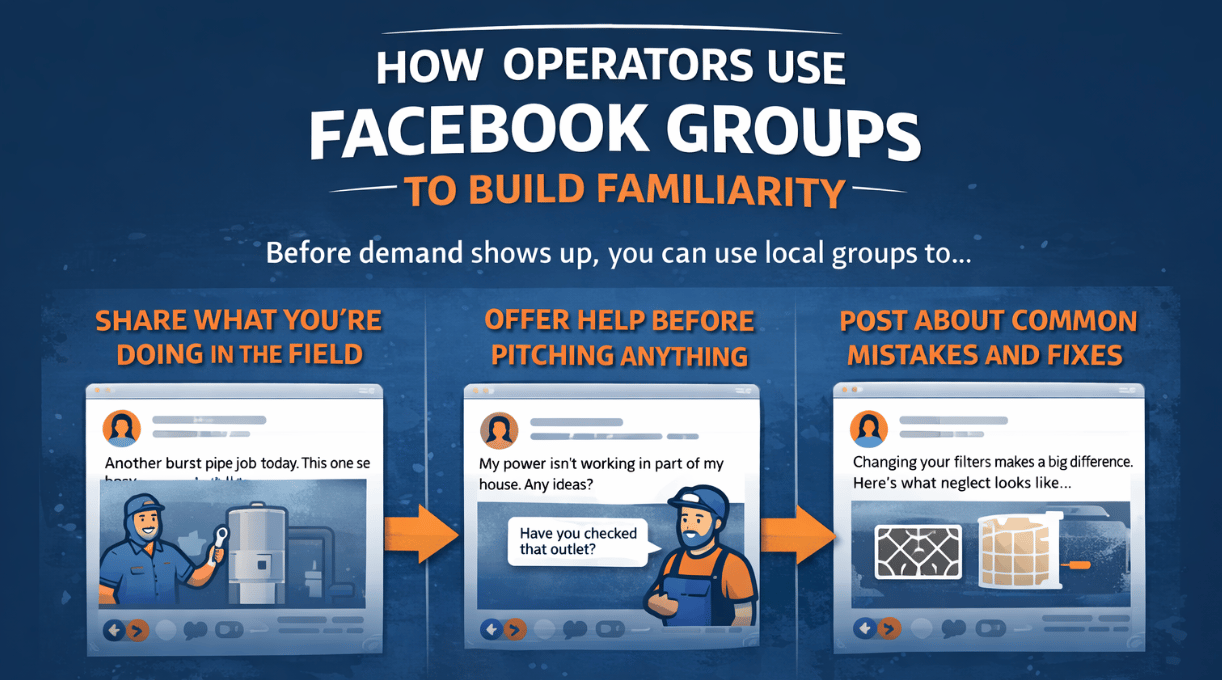
The operators who see results follow a different pattern. They use groups to build familiarity before demand shows up.
Here’s what that looks like in practice:
Groups are treated as a community, not an ad slot
Storytelling replaces promotions
Consistent presence matters more than frequency
The distinction is simple.
Facebook groups do not create demand. They influence who gets chosen when demand already exists.

What Facebook Groups Are Becoming
As marketing budgets scale from roughly $200,000 to $1,000,000, the strategy behind them rarely changes. Operators buy more leads, push more demand generation, and expand the same channels. Spend increases, but differentiation does not.
At the same time, social media has split into two extremes. Most service businesses either keep it barely active or commit to expensive, in-house production teams. Casual posting no longer competes, and the middle ground is disappearing.
Facebook groups are filling that middle ground.
They sit between high-cost content and pure lead buying. They reward presence instead of production. And they compound familiarity in a way paid channels do not.
What this channel is increasingly replacing:
The need for constant promotional posting
Over-reliance on discounts to get attention
Expensive content just to stay visible
Brand building that only happens through ads
Another clear signal is where intent shows up. Homeowners use groups to ask for recommendations, not to browse offers. Businesses that show up early, consistently, and without pitching become the default choice when urgency hits.
The direction is clear. As paid channels get louder and social content becomes more resource-intensive, Facebook groups are emerging as a practical marketing channel where trust, not budget size, determines who gets the call.

Facebook Groups → More Calls
Facebook groups only work when you treat them differently than every other channel. The operators who win follow a few consistent rules.
1. Stop Treating Groups Like Ad Inventory
The fastest way to fail in Facebook groups is to sell too early.
Most businesses post:
Discounts
Promotions
“Buy now” offers
That trains the group to ignore you. Instead, treat the group like a room you walk into regularly. You do not pitch the room. You earn familiarity inside it.
Action: Make a hard rule that you do not post offers, coupons, or CTAs in groups.
2. Use Story, Not Offers, as the Hook
What works in groups is storytelling. Not polished brand stories. Simple, human ones.
The businesses that perform well:
Talk about what they do
Share perspective
Show how they think
Explain problems without selling solutions
This builds recognition without triggering resistance.
Action: Post short, plain-language updates that explain:
What you’re seeing in the field
Common mistakes homeowners make
How you think about quality and trust
No pitch at the end.
3. Show Up Consistently, Not Frequently
Groups reward presence, not volume.
Here’s a contrast of two behaviors:
Businesses that barely show up
Businesses that spam
Both lose.
The operators who win show up consistently over time. They comment. They respond. They participate like members, not advertisers.
Action: Pick a small number of relevant local groups and commit to:
Commenting regularly
Answering questions when they appear
Posting occasionally, not daily
Think months, not weeks.
4. Let Recommendations Do the Selling
The real payoff in Facebook groups happens when you are not in the thread.
Homeowners use groups to ask:
“Who do you trust?”
“Who should I call?”
If you have built familiarity, other members do the selling for you.
That is the conversion moment this channel is designed for.
Action: Track:
How often your name is mentioned
Who is tagging you
What language people use when they recommend you
That is the signal the channel is working.
5. Understand the Role of the Channel
Facebook groups are not a lead faucet. They are a preference engine.
They do not create demand. They influence who gets chosen when demand already exists.
That is why they sit between paid ads and organic marketing. They shape trust before urgency hits.
Action:
Do not measure success by clicks or form fills. Measure it by:
Branded calls
“I see you in the group” mentions
Recommendation-based inbound
That is how this channel actually converts.


…And Why They Kill Results
These are the mistakes that keep Facebook groups from ever leading to inbound calls:
Treating groups like ad space
Posting discounts, promos, or “buy now” offers
Showing up once, then disappearing
Posting only when you need business
Talking about yourself instead of helping
Expecting leads instead of earning familiarity
Most operators burn credibility before they ever build recognition. Don’t go down that path.
Never Lose Context Again
Every customer conversation matters. Quo keeps every call, text, voicemail, and message in one shared view, so no context ever gets lost.
Your team sees the full customer history the moment they pick up the phone, collaborates without handoffs, and delivers a consistent experience every time.

The hardest part is starting. Join a few relevant Facebook groups and show up using the approach above. That first step puts you in an underused channel where branding compounds and demand turns into calls over time.

👊 John
Disclosure: Some of the content and links in this newsletter are sponsored or affiliate links, which means we may receive payment or earn a commission if you click through or purchase. However, all opinions expressed are entirely my own.
Want More Owned and Operated?
📰 Subscribe to the JackQuisitions newsletter here
📰 Subscribe to the Entry & Exit newsletter here
🤝 Get your brand in front of 40,000+ home service business owners here
Reply