- Owned and Operated
- Posts
- The Marketing Stack From $0 to $10M


Most contractors think bigger companies use completely different marketing.
They don’t.
I talked with Ethan Wright from Service Scalers about what marketing actually looks like from $0 to $10M, and the pattern is clear.
The companies going from $1M to $10M are mostly doing the same things.
They just do them faster, with more discipline, and with better tracking.
Today I’ll break down what marketing actually looks like at:
$1M
$5M
$10M
Check out these resources before we get started…
From May 5-7, I show you exactly what it takes to break through the $5M barrier
I love stories like this: the PHCC Educational Foundation just crowned the winners of its redesigned National HVAC Apprenticeship Competition, raising the bar for the next generation of skilled trades
“I am deeply proud to surpass a $1B annualized revenue run rate and to see our vision unfold faster than we ever could have imagined.”
Which publicly traded company’s CEO said this?

How Marketing Evolves As You Scale a Service Business
One of the questions I get all the time is how marketing should change as a home service company grows. The answer is simpler than most people expect…
The marketing stack does evolve from $0 to $10M, but the fundamentals stay the same the entire time. You need leads, you need to respond fast, and you need to convert at a high level.
As the business gets bigger, the tools get better, the tracking gets tighter, and the budgets get larger. What does not change is the goal. Keep the board full, keep the phones answered, and keep technicians running profitable calls.
In this issue, I want to break down how the marketing stack actually changes from startup to $10M, based on what we are doing today across branches at different sizes.
This is not theory. We are running the $1M playbook, the $5M playbook, and the $10M playbook at the same time right now.
Stop Missing Calls. Start Adding Revenue.
If you’re growing, you already know about a massive bottleneck: hiring qualified people.
We’ve been using Quick Staffers to add trained CSRs, outbound callers, and back-office support without the cost and headache of hiring locally. Their team is built specifically for home service companies, so they understand ServiceTitan, call booking, dispatch, and the pace we operate at.
And the results we’re seeing, along with other service companies, are beyond encouraging.
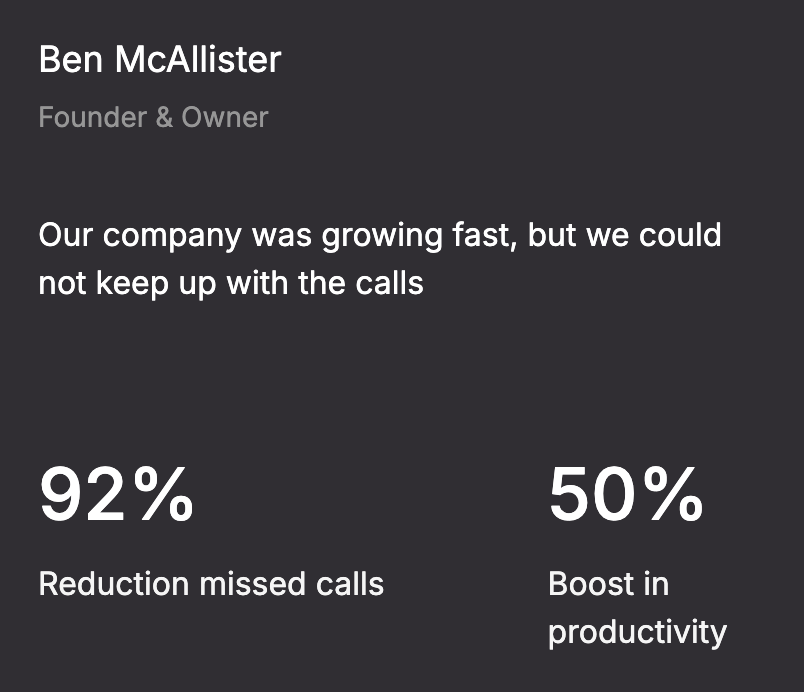
Instead of missing calls or overloading your office, you can plug in pre-trained talent starting around $550 per week and scale as you grow.
Quick Staffers has helped contractors generate millions in revenue just by making sure the phone gets answered and the work gets booked.

The Fundamentals Do Not Change As You Grow
One of the biggest misconceptions about marketing is that it gets completely different as the business gets bigger. In reality, the core job stays the same from $1M to $10M. You need leads coming in, you need to respond faster than your competitors, and you need to turn those leads into booked, profitable jobs.
What changes as you scale is not the goal, it is the level of sophistication. At $1M, marketing might be Local Service Ads, reviews, and answering the phone fast. At $5M, you are running multiple channels, tracking ROI, and investing more aggressively. At $10M, you have a real machine with attribution, lifecycle marketing, outbound, and dedicated budget management.
We are living this right now across different branches. Some of our locations are still in the $1M–$3M range, some are pushing past $5M, and others are well beyond that. The playbook is not different, but the way you execute it is.
Every time we take over a smaller shop, the first moves are almost always the same. More leads, better speed to lead, better follow-up, and tighter sales execution.
Owners love to think the answer is a new channel, a new agency, or a new brand strategy. Most of the time the answer is much simpler. Turn up the lead flow, respond faster, and make sure you can actually convert the work you are already paying for.

Signals Across Different Size Shops
One of the advantages of running multiple branches at different sizes is that you start to see patterns. The marketing stack from $1M to $10M is not just theory for us right now. We have locations in the $1M range, others around $3M–$5M, and branches well past $10M, all running at the same time. When you look across all of them, the signals are very consistent.
The first signal is how much growth can come from simply turning on lead flow. In one branch we took over, the company had done about $1.4M the previous year. We increased lead spend, installed better speed-to-lead systems, and focused on booking rate. The business nearly doubled within the first 30 days. Nothing fancy. Just more leads, faster response, and better execution.
Another signal is how much technology impacts performance. In several smaller shops, the issue was not demand, it was response time. Leads were coming in, but nobody was calling back fast enough, texting fast enough, or following up consistently. Once speed-to-lead tools were added, the same lead sources started producing dramatically better results. The difference was not the channel. It was the system behind it.
We are also seeing a clear trend in how review count affects lead cost. In more competitive markets, a shop with 75 reviews struggles to get traction on Local Service Ads, while competitors with hundreds or thousands of reviews dominate the results. In less competitive markets, the opposite happens. A company can turn on LSA and immediately triple lead volume simply because nobody else is investing in it yet. The gap between operators who focus on reviews and operators who do not keeps getting wider.
Another trend is how customer databases become more valuable as the business grows. In one smaller branch, the company had several thousand past customers but was doing almost nothing with the list. Once outbound calling and follow-up campaigns started, the shop could book jobs without spending heavily on new leads. At small sizes, a handful of extra calls per day can completely change the schedule. At larger sizes, the same idea turns into a full lifecycle marketing system.
The last signal is how often pricing is the real constraint, not marketing. When an owner says leads are too expensive, the first question should be average ticket and margins. In one example discussed, leads might cost $500, which sounds high, but the average job was several thousand dollars with strong margins. At that point, the lead cost does not matter. The operators who understand their numbers can buy more leads, grow faster, and take share from competitors who cannot.
Across every size range, the pattern is the same. Growth does not usually come from discovering a new marketing trick. It comes from running the fundamentals harder, tracking the numbers better, and making sure the business can support the lead flow it is trying to buy.

Breakdown by Revenue
Here’s what the marketing strategy actually looks like from startup to eight figures.
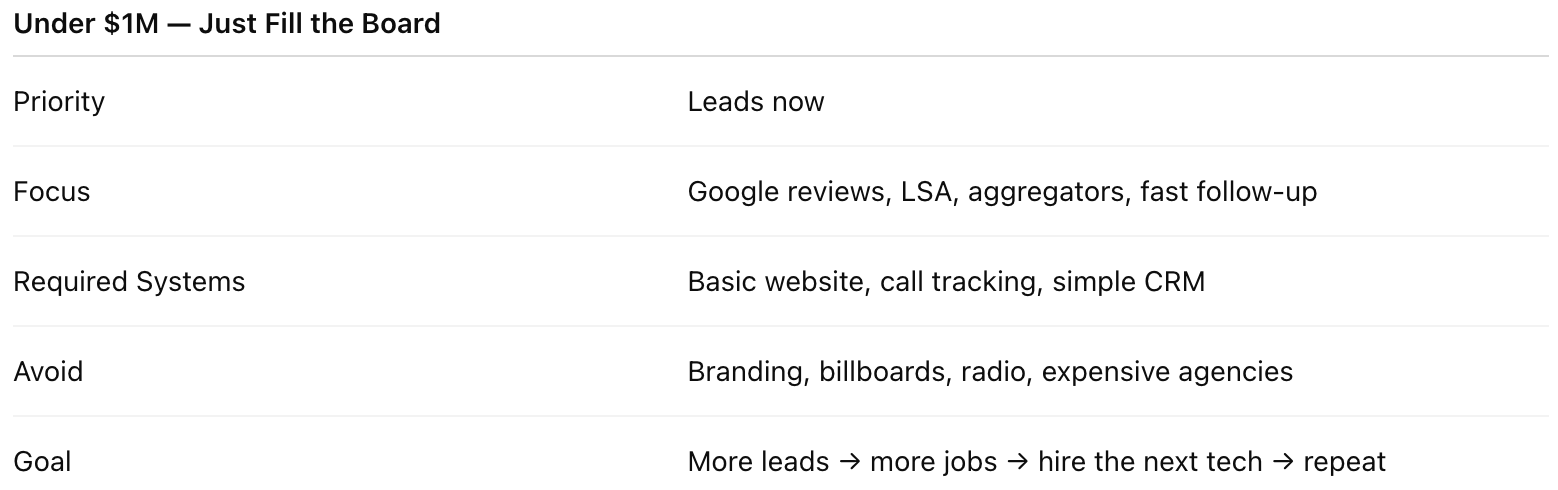
Under $1M — Just Fill the Board
At this stage, marketing is simple. You need leads now.
$1M–$5M — Do the Same Things Better
Most growth here comes from execution, not new tactics.

Around $5M — Add Scalable Channels
Once budget grows, you can support more advanced marketing.

$5M–$10M — Build the Machine
Now the biggest unlock is not new leads.
It is using the leads you already have.

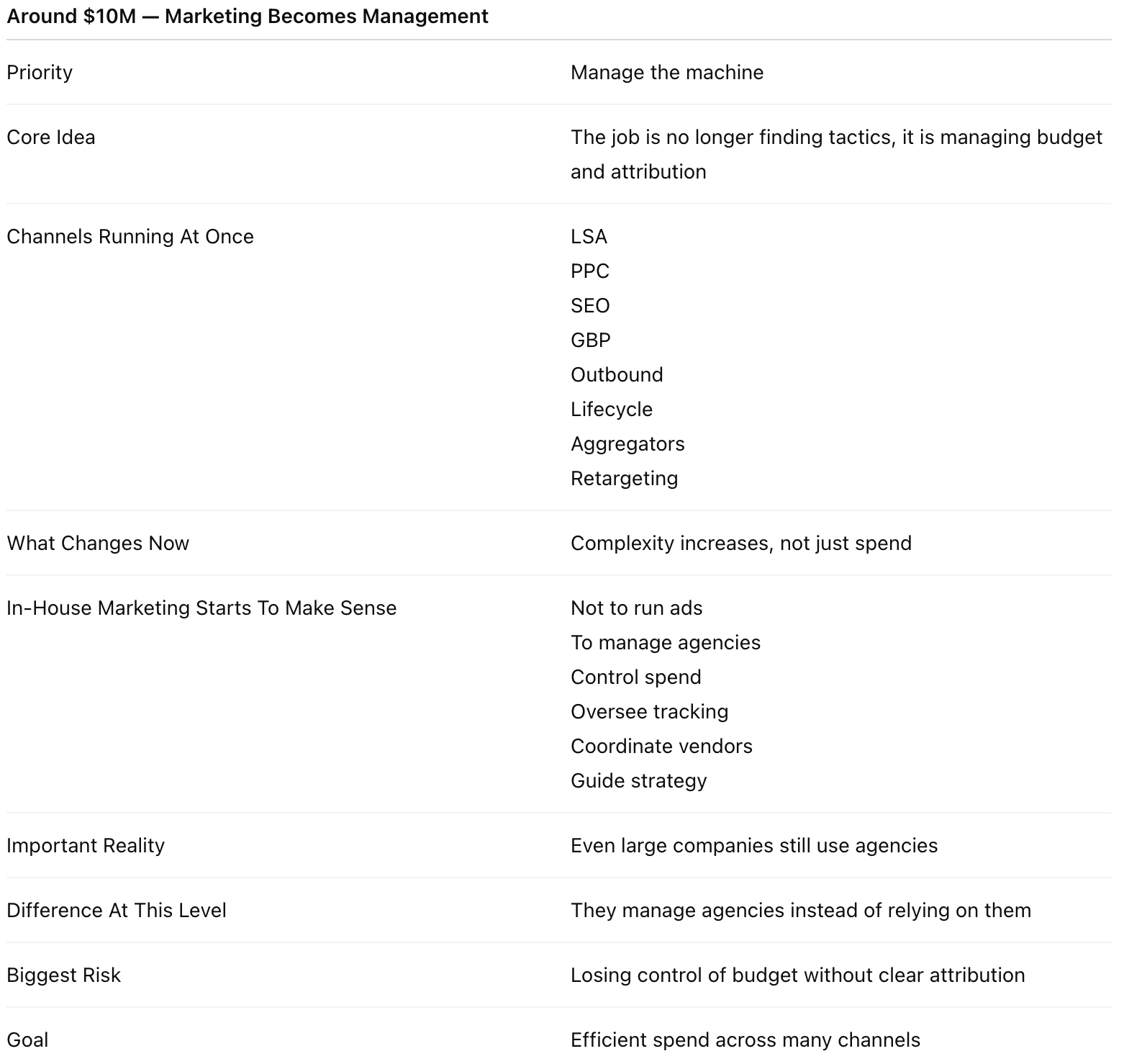
Around $10M — Marketing Becomes Management
At this stage, you usually have multiple channels running at once.
The Reality
From $1M to $10M, the playbook does not change.
You always need:
More leads
Faster response
Better conversion
Better tracking
Bigger budget
More discipline

Where Marketing Stacks Go Off Track
After working with shops from $1M to $40M+, the same marketing mistakes show up again and again.
Spending on brand too early: Billboards, radio, and expensive branding feel like progress (and sometimes they are), but they rarely drive calls when you are under $5M. Early on, you need leads, not awareness.
Hiring a marketing person too soon: A full-time marketing hire at $2M–$5M usually costs more than they produce. At this stage, that money should go toward leads, tech, and tracking.
No speed-to-lead system: If you are not calling or texting within seconds, you are losing jobs. Most shops think their lead sources don’t work, when the real problem is slow follow-up.
Ignoring reviews and GBP: Your Google Business Profile is still the highest ROI marketing channel for most home service companies. Too many owners stop pushing reviews once they get busy.
Focusing on cost per lead instead of ROI: Cheap leads don’t matter if they don’t book. Expensive leads don’t matter if the ticket is high. Track revenue, not just lead cost.
Not using your customer list: Outbound calls, reminders, and win-backs are some of the cheapest revenue you can generate. Most companies have thousands of past customers and never contact them.
Overcomplicating the stack: Owners think bigger companies use completely different marketing. They don’t. They just buy more leads, respond faster, and track better.
12 Months of Free Marketing ($100K Value)
One growth-focused home service company will receive up to $100,000 in PPC, SEO, website, LSA, and retargeting services from Service Scalers over the next 12 months.
This is a full partnership built to drive real calls, real leads, and real booked jobs, not impressions or vanity metrics. Book a discovery call and mention the giveaway to enter before the March 28 deadline.

There is no secret marketing channel waiting at the next level. Growth comes from doing the same things better, with the right budget, the right tech, and the right follow-through.

What do you think about today's "Clicks to Calls" newsletter? |
👊 John
Disclosure: Some of the content and links in this newsletter are sponsored or affiliate links, which means we may receive payment or earn a commission if you click through or purchase. However, all opinions expressed are entirely my own.
Want More Owned and Operated?
📰 Subscribe to the JackQuisitions newsletter here
📰 Subscribe to the Entry & Exit newsletter here
🤝 Get your brand in front of 40,000+ home service business owners here
Reply